Michigan Trucking Law
Someone could say “We wrote the book, we are connected, and we do our research.”
See below for State Specific Law for Michigan
We have extensively researched, worked with, and associated with the finest trucking injury attorneys in Michigan and across the country. Our network of specializing attorneys has a proven winning record in Michigan, and in your state. See our Results Page to view Million Dollar Winners. |
 |
Call NOW and speak to Attorney Jason Waechter personally. We want to get our vast network of experts and truck injury accident attorneys working on your Michigan semi truck case immediately. CALL NOW: 1-800-708-5433
BOOK: Well, it’s a reference guide that helps attorneys litigate, and helps injured victims understand serious negligence cases or injury accident cases involving Michigan tractor trailers, or semi trucks.
CONNECTED: Attorney Jason Waechter is a member of the most prestigious national trucking organizations for lawyers, American Association for Justice’s Trucking Litigation Group.
RESEARCH: Attorney Jason Waechter has developed expertise in litigating serious injury and death accidents involving Michigan tractor trailers (semi trucks) and other commercial vehicles. We have extensively researched, worked with, and associated with the finest trucking injury attorneys across the country, in Michigan and in every state nationwide. Our network of specializing attorneys has a proven winning record in Michigan and in your state.
Law Offices Jason A. Waechter
No Win, No Fee; FREE Advice
|
Southfield 19080 W. 10 Mile Southfield, MI 48075 248-355-4701 |
Flint 717 S. Grand Traverse Flint, MI 48502 810-496-9528 |
Grand Rapids 250 Monroe Ave. NW, #400 Grand Rapids, MI 49503 616-855-1192 |
Detroit 18650 W. McNichols Detroit, MI 48219 313-879-4607 |
Mt. Clemens 120 Market St. Mt Clemens, MI 48043 586-203-8971 |
Ann Arbor 2452 E. Stadium Blvd, Ste 301 Ann Arbor, MI 48104 877-245-3752 |
1-800-708-5433
Satellite offices in:
Flint, Grand Rapids, Detroit, Mt. Clemens & Ann Arbor.
To associate with the best lawyers, we have researched the legal periodicals, law journals, verdict reports, and many other materials. These lawyers have winning verdicts, have won awards, speak at seminars teaching other attorneys, and all have excellent reputations. They are known and respected by judges and defense attorneys and fear and revered by insurance companies.
Call us immediately for free advice and a free assessment of your Michigan tractor trailer (semi truck) or commercial vehicle causing serious injury or death case. If the Law Offices of Jason A. Waechter do not personally handle your case, we will associate with or refer you to a proven specialist in the state the accident took place, all with the same no win, no fee promise. Just because two law firms are involved never means you pay more than the typical contingency fee. (To state this another way, you may get two firms for the same fees as one and there are no fees unless we collect money for you.)
Call now. Do not wait. Waiting could mean the difference between winning and losing. The faster you retain a firm and the sooner the Michigan tractor trailer or semi truck accident is investigated by us, our accident reconstructionists, or trucking investigators, the better the chance of preserving evidence to prove a substantially winning case for you and your family. Remember you are not obligated in any way when you call. When you call our firm, you will speak to the firm’s owner, Attorney Jason A. Waechter. CALL NOW! 1-800-708-5433
MILLIONS of dollars have been paid to our accident injury clients. Make sure you are one of them. CALL NOW! Attorney Jason Waechter, 1-800-708-5433.
The following law may apply to a Michigan tractor trailer, or semi truck, accident or other commercial vehicle accident. The Federal Motor Carrier Safety Regulations (FMCSR) are the rules that govern semi trucks on our highways, and have been adopted by the state of Michigan. They include rules drivers, their employers, and owners of trucks must follow. The Federal Motor Carrier Safety Regulations that most certainly apply to any injury or death involving the negligence of a truck driver or a driver of a tractor trailer (semi truck) or perhaps other commercial vehicles can be found at: www.fmcsa.dot.gov. The federal law in its entirety can be found in Title 49 of the Federal Code.
Michigan Trucking Law
Michigan tractor trailer, or semi truck accident law may be a little different than the federal law. Some of the highlights are listed below.
- The federal regulations that governs semi truck, or tractor trailer, accidents is “The Federal Motor Carrier Safety Regulations”, which can be found at the website:
- The Michigan state law that governs semi truck accidents in Michigan is called the “Motor Carrier Safety Act of 1963”. Michigan Trucking Law that governs Michigan semi truck accidents can be found at the following link:
- MICHIGAN SEMI TRUCK DRIVER QUALIFICATIONS:
Both federal and Michigan state safety regulations require that Michigan drivers of semi trucks (tractor trailers) meet certain qualifications. Each Michigan driver employed by a motor carrier is required to have a “driver qualification file”.
- Age:
i. Interstate Travel: (traveling within 2 or more states). The required age of a Michigan driver is at least 21 years old.
ii. Intrastate Travel: (within a single state). The required age of a Michigan driver is at least 18 years old.
- Language:
i. English: Michigan semi truck driver must be able to speak, understand, and converse in the English language.
ii. Michigan driver must understand traffic signs.
iii. Michigan driver must be able to make records and reports in English.
- Operation of Michigan Motor Carrier (Employer):
i. Experience or training qualifies Michigan driver to safely operate a Michigan semi truck or Michigan commercial vehicle
ii. Has physical capability to operate motor carrier
iii. Michigan drivers are required to reduce speed and to take into consideration bad weather conditions. A Michigan semi truck driver must reduce speeds for snow, ice, fog, rain, smoke, dust, or other conditions that affect visibility or traction adversely. Certain conditions make it a requirement for the Michigan driver to stop their vehicle all together.
1. Must take into account weather conditions (§392.14)
- Valid Michigan License:
i. Michigan semi truck driver must possess a currently valid C.D.L. (Commercial Driver’s License)
ii. Issued by Michigan
iii. Successfully completed Michigan road test
- Michigan Certifications:
i. Has any and all certifications required by Michigan employer / Michigan motor carrier
ii. Is not disqualified to operate a Michigan semi truck / Michigan motor carrier
- Michigan Driver Responsibility:
- Hours of Service
i. The driver of a Michigan semi truck (tractor trailer) may not drive more than 11 hours following at least 10 consecutive hours off duty. (§395.3) The reason for these hour restrictions is to prevent driver fatigue. It has been a proven fact that driver fatigue often is a cause of interstate trucking accidents. The trucking carrier and the driver are both responsible for this type of Hours-of-Service (HOS) violation.
1. Michigan drivers can only drive 11 consecutive hours, after resting for at least 10 hours. (§395.3) Failure to comply with this rule constitutes an Hours-of-Service (HOS) violation.
- Truck Driver Logs
i. A Michigan tractor trailer (semi truck) driver is required to keep certain specific logs to prove that he or she has not violated these Hours-of-Service rules. The Michigan employer or motor carrier is required to inspect the drivers’ logs to confirm compliance with these regulations.
1. Drivers must log their hours every 24 hours, in written format. (§395.8)
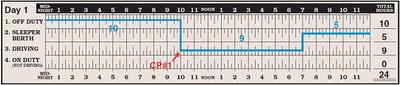
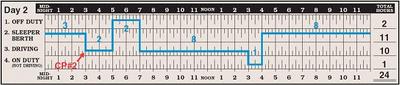
ii. Driver Logs: §395.8 involve a Michigan driver making a record of his duty status. A Michigan driver must keep a log of his or her status for every 24 hour period. Pursuant to Section 395.8 of the Federal Motor Carrier Safety Regulations, the log is usually in written form and on a grid.
iii. Because of technology, the Michigan driver log is often kept by an on-board recording device. The log indicates when the Michigan driver is on and off duty and whether they are driving or in the “sleeper birth”, which is usually designated as “SB”. The Michigan motor carrier is responsible if the tractor trailer driver submits a false log.
1. There are sometimes investigations regarding whether a Michigan driver keeps two sets of logs or books, so that he or she could driver longer than they are allowed to drive by Michigan law.
iv. The following is an example of an Hours-of-Service truck driver log with no driving violations recorded:
i. A Michigan motor carrier (that would be the trucking company) is responsible and required to fashion or schedule their Michigan truck driver’s runs and routes in a way that would allow Michigan drivers to complete them without violating any speed limits or Hours-of-Service violations.
1. The company that employs the driver must schedule drivers in such a way that they will not violate their Hours of Service. (§392.6)
ii. Michigan tractor trailer (semi truck) drivers must follow posted speed limits. Trucks, often times, must follow a lower speed limit that drivers of cars.
1. Michigan semi-truck drivers must obey traffic laws, and follow speed limits at all times.
- Alcohol
i. Alcohol and drivers of Michigan tractor trailers (semi trucks): A trucker cannot have any alcohol in his or her system at all while driving a tractor trailer (semi truck). This, of course, includes driving, but also when Michigan drivers are merely “on duty”, which would include even if they were not driving, but where they are in physical control of the truck.
ii. Alcohol is not tolerated whatsoever, which is different from drivers of cars, certain vans, and motorcycles that have alcohol in their system up to certain limits, and still may be able to legally drive. The rules involving Michigan truck drivers are extremely strict.
1. There is no tolerance for any amount of alcohol in a Michigan truck driver’s system while operating a semi-truck or while in the physical control of a semi-truck. (§392.4-.5)
- Truck Equipment & Repair
i. A driver of a Michigan tractor trailer (semi truck) must make sure that his or her truck (trailer, or cab) and its equipment are in good working order at all times.
1. A Michigan driver must maintain the semi-truck and its equipment is in good working order at all times. (§392.7)
ii. This section of the Federal Motor Carrier Safety Regulations includes brakes to the tractor, brakes to the trailer, parking brakes, steering devices, lighting devices, tires, horn, windshield wipers, rear vision mirrors, and coupling devices (a coupling device is analog shift register, that transports analog signals or electric charges).
iii. The Michigan driver is responsible to make sure even their emergency medical equipment is in working order and legal at all times. The truck driver has a duty to inspect it and use it.
1. A Michigan driver must make sure that emergency medical equipment is in place and ready to be used at any time. (§392.8)
iv. A Michigan driver must make sure that emergency equipment is in place and ready to be used at any time. (§393.95)
- Disqualifications of Driver:
i. Michigan motor carriers, or employers or semi truck drivers, do not have the authority to disqualify a semi truck driver. Disqualifying offenses are listed in the Federal Motor Carrier Safety Regulations. (§383; §391).
ii. Some disqualifying offenses of Michigan semi truck drivers include (but are not limited to):
1. Driving with a revoked or suspended license
2. Driving while under the influence of alcohol or drugs
3. Leaving an accident scene that involves a commercial motor vehicle (semi truck)
4. Committing a felony with the use of a commercial motor vehicle (semi truck)
5. Speeding, or Reckless Driving
6. Improper and/or erratic traffic lane changes
7. Following another vehicle too closely when driving the semi truck
8. Railroad crossing violations when driving the semi truck
- Law: 49 C.F.R. (Click the following link to be taken to the law in its entirety: Title 49 Law)
- FALLEN CARGO: Many Michigan semi truck accidents occur because cargo has fall from the Michigan truck’s trailer and injured another Michigan motorist. Often when Michigan semi truck accidents occur because of fallen cargo it is a result of the Michigan driver not securing the cargo properly. There are certain rules that Michigan semi truck drivers must follow when securing cargo.
- LAW: Michigan adopts “The Federal Motor Carrier Safety Regulations”, which is Title 49 of the Federal Code, with some modifications for the state of Michigan.
- LAW: Motor Carrier Safety Act of 1963 – Act 181 of 1963
i. “AN ACT to promote safety upon highways open to the public by regulating the operation of certain vehicles; to provide consistent regulation of these areas by state agencies and local units of government; to establish the qualifications of persons necessary for the safe operation of such vehicles; to establish certain violations of shippers offering certain materials for transportation; to limit the hours of service of persons engaged in operating such vehicles; to require the keeping of records of such operations; to provide penalties for the violation of this act; to prescribe the powers and duties of certain state agencies; and to repeal acts and parts of acts.”
480.11a Adoption of federal regulations; exceptions; definitions.
Sec. 1a.
(1) This state adopts the following provisions of title 49 of the code of federal regulations, on file with the office of the secretary of state except where modified by this act:
(a) Hazardous materials regulations, being 49 CFR parts 100 through 180 except for the transportation of agricultural products for which an exception from the application of 49 CFR subchapter C and 49 CFR subchapters G and H, part 172, is provided under 49 CFR 173.5, is specifically authorized if the transportation is in compliance with this act and other state law.
(b) Motor carrier safety regulations, being 49 CFR parts 40, 356, 365, 368, 371 through 373, 375, 376, 379, 382, 385, 387, 390 through 393, 395 through 399 including the appendices of each part except for the following:
(i) Except as provided in this subparagraph, where the term "United States department of transportation", "federal motor carrier safety administration", "federal motor carrier safety administrator", "director", "bureau of motor carrier safety", "pipeline and hazardous materials administration", or "associate administrator for hazardous materials safety" appears, it refers to the department of state police. If the term is being used for the purposes of 49 CFR 397 as it relates to routing and movement of hazardous materials, it refers to the Michigan state transportation department.
(ii) Where "interstate" appears, it shall mean intrastate or interstate, or both, as applicable, except as specifically provided in this act.
(iii) Where "special agent of the federal motor carrier safety administration", "administration personnel", or "hazardous materials enforcement specialist" appears, it either means a peace officer or an enforcement member of the motor carrier division of the department of state police.
(iv) Where MCS 63 appears, it means MC 9 and MC 9b.
(v) Where MCS 64 appears, it means UD-70.
(vi) Exempt intracity zones and the regulations applicable to exempt intracity zones do not apply to this act.
(2) This act does not apply to a bus operated by a public transit agency operating under any of the following:
(a) A county, city, township, or village as provided by law, or other authority incorporated under 1963 PA 55, MCL 124.351 to 124.359. Each authority and governmental agency incorporated under 1963 PA 55, MCL 124.351 to 124.359, has the exclusive jurisdiction to determine its own contemplated routes, hours of service, estimated transit vehicle miles, costs of public transportation services, and projected capital improvements or projects within its service area.
(b) An authority incorporated under the metropolitan transportation authorities act of 1967, 1967 PA 204, MCL 124.401 to 124.426, or that operates a transportation service pursuant to an interlocal agreement under the urban cooperation act of 1967, 1967 (Ex Sess) PA 7, MCL 124.501 to 124.512.
(c) A contract entered into pursuant to 1967 (Ex Sess) PA 8, MCL 124.531 to 124.536, or 1951 PA 35, MCL 124.1 to 124.13.
(d) An authority incorporated under the public transportation authority act, 1986 PA 196, MCL 124.451 to 124.479, or a nonprofit corporation organized under the nonprofit corporation act, 1982 PA 162, MCL 450.2101 to 450.3192, that provides transportation services.
(e) An authority financing public improvements to transportation systems under the revenue bond act of 1933, 1933 PA 94, MCL 141.101 to 141.140.
(3) As used in this act:
(a) "Hazardous material vehicle inspection or repair facility" means a commercial enterprise that performs inspections, certification, testing, or repairs to commercial motor vehicles transporting hazardous materials as required by 49 CFR parts 100 to 180 and includes motor carriers that perform the inspections, certification, testing, or repairs to vehicles owned or leased by the motor carrier.
(b) "Medical examiner" means that term as defined under 49 CFR 390.5.
- MICHIGAN IS A NO-FAULT STATE.
- First Party: If you are involved in a Michigan semi truck accident, regardless of who was at fault, your insurance company will cover most economic damages. These economic damages are called first party benefits.
i. Michigan first party benefits (economic) may include:
1. Wage Loss
2. Medical Bills
3. Attendant Care
4. Replacement Services
5. Mileage Reimbursement
- Third Party: If you are involved in a Michigan semi truck accident, you may be entitled to non-economic damages for pain and suffering. These non-economic damages are called third party benefits.
i. Michigan third party benefits (non-economic) may include:
1. Pain and Suffering
2. Scarring and/or Disfigurement
3. Serious Impairment of Important Body Function
4. Death
ii. If you are injured in a Michigan semi truck accident, and you want to seek non-economic damages, you must meet a “threshold injury”.
1. Serious Impairment of a Bodily Function
2. Scarring and/or Disfigurement
3. Death
iii. Statute of Limitations: 3 years
1. If you choose to seek non-economic damages as a result of your Michigan semi truck accident, you must do so within 3 years from the date of the Michigan semi truck accident.
- MICHIGAN TRUCKING WEBSITE LINKS
- Michigan Public Service Commission – MPSC
(517) 241-6030
- Michigan Department of Transportation
(517) 373-2120
- Michigan State Police – Motor Carrier Division
- Commercial Vehicle Safety Alliance
- American Trucking Associates
- Michigan Center for Truck Safety
- Michigan Trucking Association
- CALL ATTORNEY JASON WAECHTER OF www.TruckAccidentLawyers-USA.com. Our associating attorneys in Michigan and each state specialize in handling injury accidents involving semi trucks, or tractor trailers. Call Jason Waechter NOW for free advice. Often, time is of the essence and quick, thorough investigation makes the difference in these specialized cases. Call and speak to Attorney Jason Waechter personally NOW! 1-800-708-5433.
*There are many exceptions, special definitions, and complex issues that cannot be explained in this material. It is not intended to be a substitute for specific legal advice. Your legal rights greatly depend on the facts of your accident.
*Law changes constantly. Do not rely on this information. Law is vast and can not be covered in this limited space.
***Law portion of site in progress. Trucking law regarding semi truck accidents is being drafted and will be updated soon. Please call our firm for a free consultation to see if you have a case.